
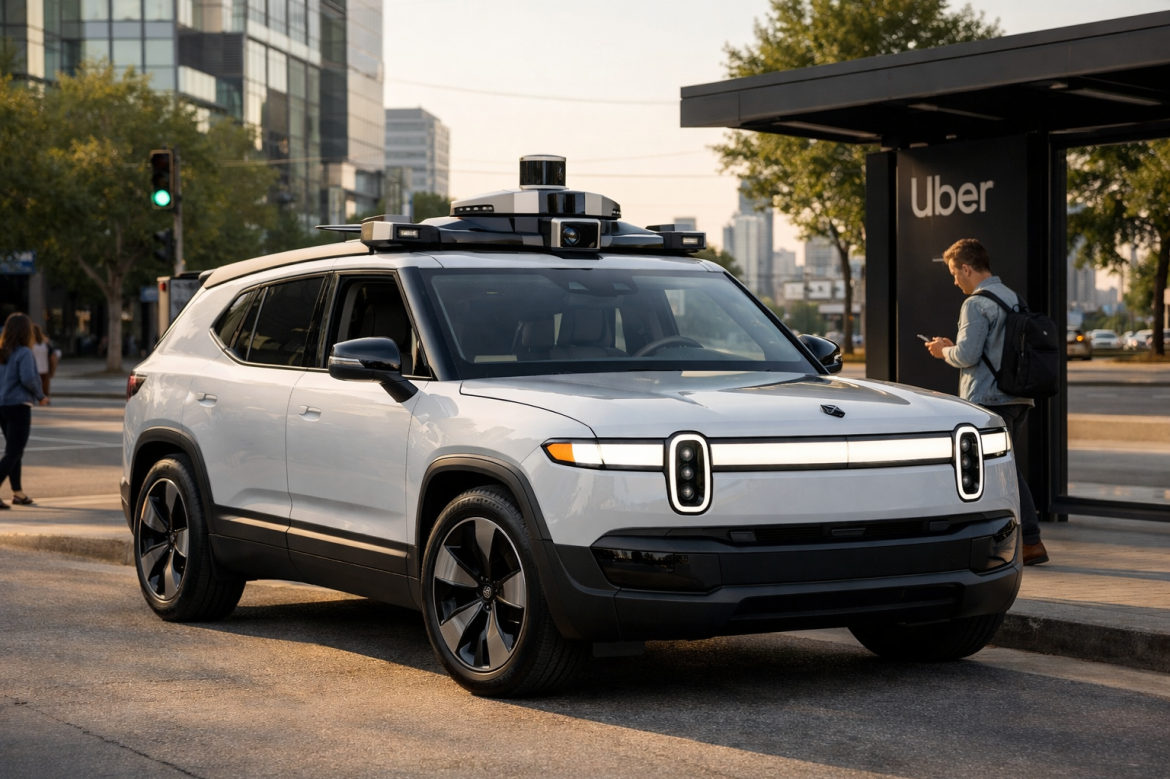
Uber, Rivian team up to scale robotaxi fleets across global cities
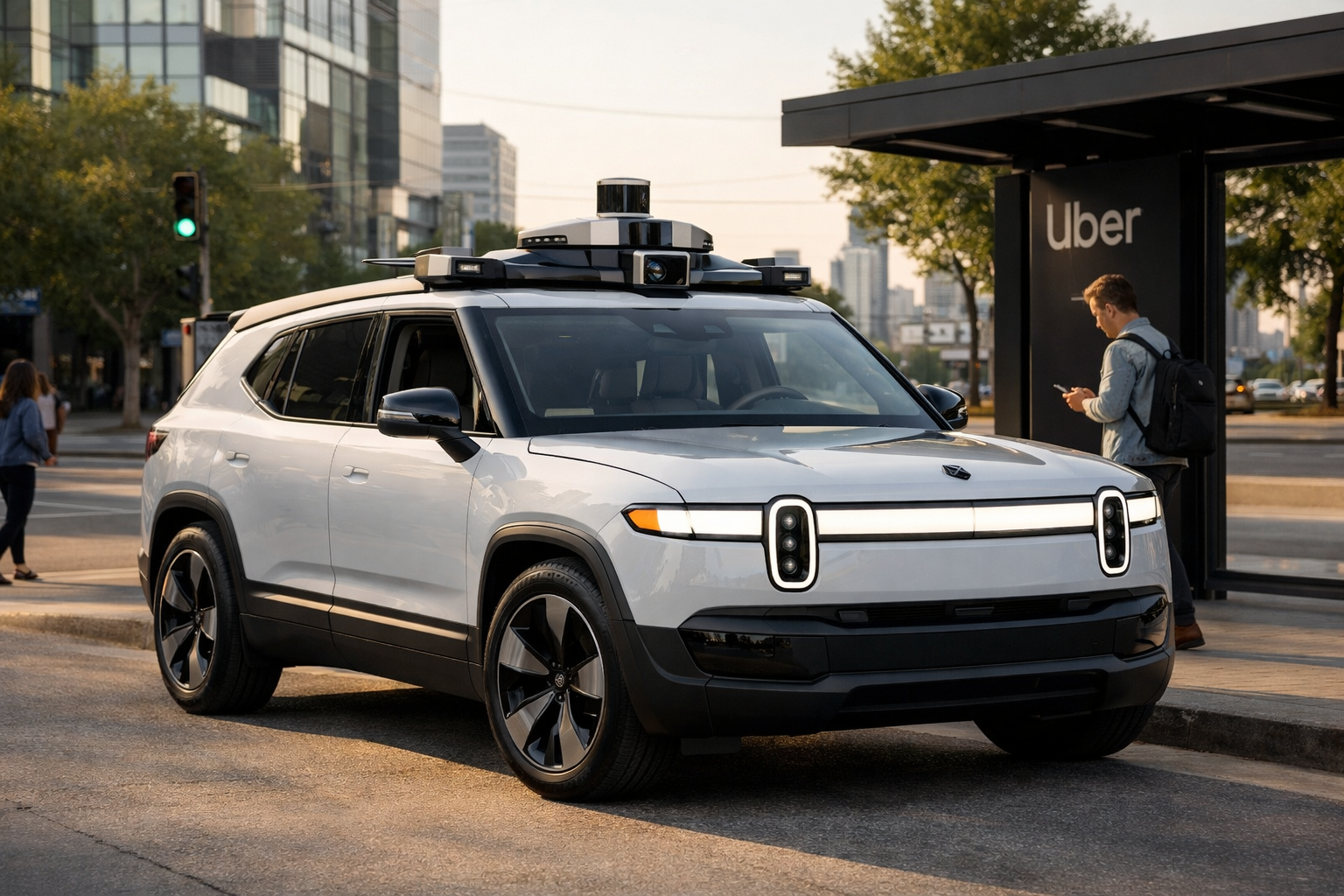
Uber Technologies is stepping up its autonomous ambitions through a new partnership with electric vehicle maker Rivian Automotive, committing to invest up to $1.25 billion to support a large-scale robotaxi rollout.
The agreement outlines plans to deploy as many as 50,000 autonomous vehicles across major markets by 2031.
It signals a renewed push by both companies to capture opportunities in self-driving mobility.
The sector has faced repeated delays but is gaining traction again as advances in artificial intelligence and computing power reshape expectations.
Investment structure and fleet plans
The deal begins with an initial $300 million investment from Uber, expected soon after signing, subject to regulatory approval.
Additional funding will be released in phases as the companies meet specific milestones through 2031.
Uber and its fleet partners are expected to purchase 10,000 autonomous versions of Rivian’s upcoming R2 electric vehicle.
The agreement also includes an option to expand that number by up to 40,000 additional robotaxis starting in 2030, allowing for a gradual increase in deployment based on progress and demand.
The R2, which Rivian plans to launch for consumers this spring, will be adapted for autonomous operations and integrated into Uber’s ride-hailing platform.
Rollout across global cities
The companies aim to introduce robotaxi services in 25 cities across the US, Canada, and Europe.
Initial deployments are planned in San Francisco and Miami in 2028, before expanding to other urban centres over time.
The vehicles are expected to be available exclusively through Uber’s platform, giving the company a central role in managing access, pricing, and operations.
This approach reflects a broader shift towards tighter integration between vehicle makers and mobility platforms.
Rivian’s autonomy push
Rivian has been increasingly vocal about its plans to enter the robotaxi space.
CEO RJ Scaringe outlined the company’s ambitions during its third-quarter results call in November and again at its “Autonomy and AI Day” in December.
The company is developing its own autonomy technology, including the RAP1 inference platform and a multi-modal perception system designed to process complex driving environments.
Rivian is also using data from its growing fleet of consumer vehicles to improve its machine learning models.
These capabilities are expected to support the R2 platform and enable large-scale autonomous deployment over time.
Broader industry momentum
The partnership comes as the robotaxi sector regains momentum, with companies revisiting timelines that were previously pushed back.
Uber has recently announced collaborations with EV maker Lucid, Amazon’s Zoox, Stellantis, and Nvidia, indicating a broad strategy built on multiple technology partners.
Rivian, meanwhile, has strengthened its position through a $5.8 billion software partnership with Volkswagen announced at the end of 2024, adding to its efforts to build a competitive technology stack.
Despite renewed activity, the industry continues to face challenges related to regulation, safety validation, and cost efficiency.
In the US, Alphabet-backed Waymo remains the leading operator in commercial robotaxi services.
Shares of Rivian rose about 10% in premarket trading following the announcement, while Uber’s stock showed little movement.
The post Uber, Rivian team up to scale robotaxi fleets across global cities appeared first on Invezz