
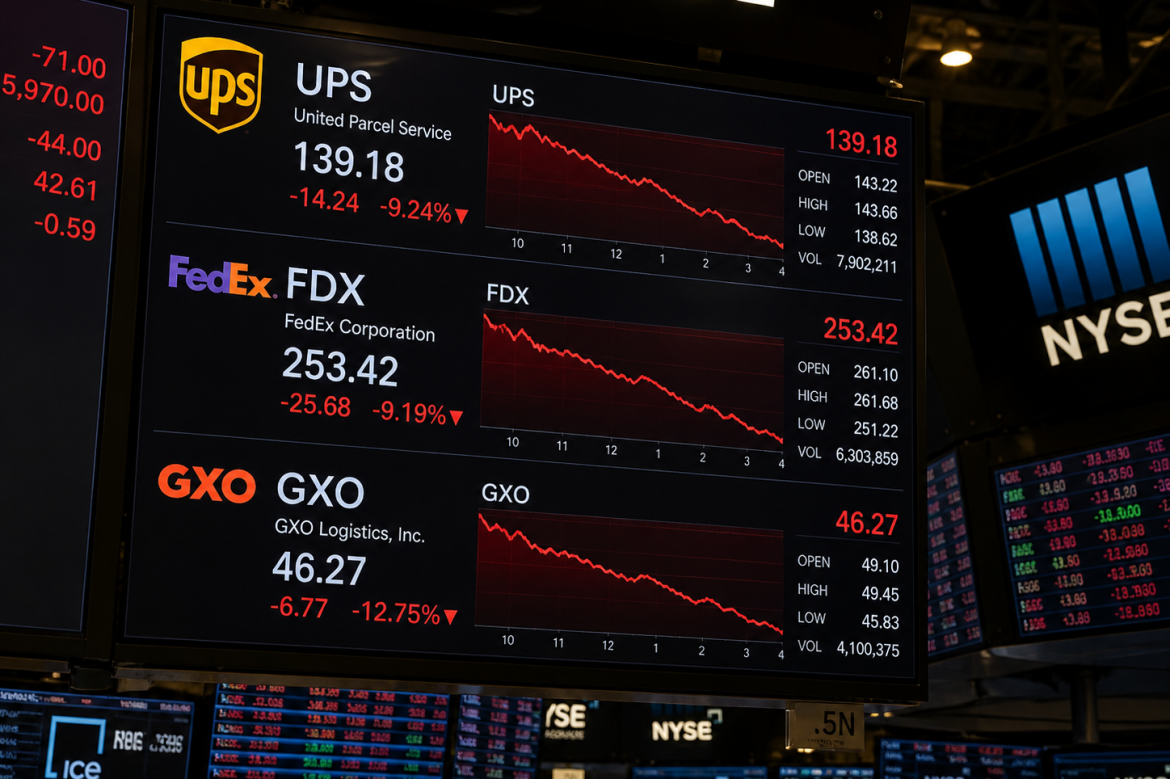
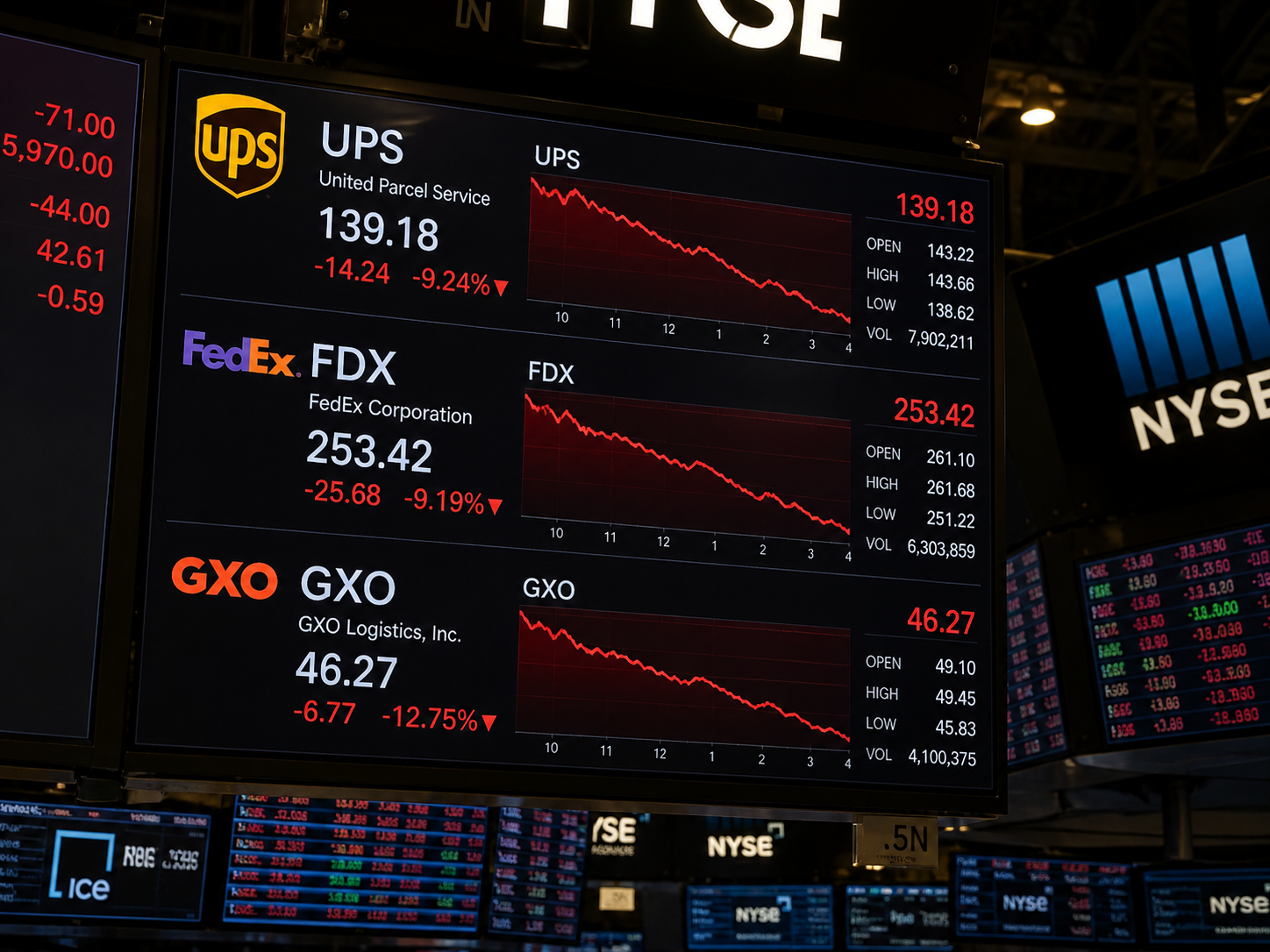
Shares of major shipping companies tumbled on Monday after Amazon unveiled a new business that opens its vast logistics network to external clients, intensifying competition in the global freight and delivery market.
The company said it is rolling out “Amazon Supply Chain Services,” allowing businesses to tap into its infrastructure for fulfillment, ocean and air freight, and trucking.
The move effectively positions Amazon as a third-party logistics provider, putting it in more direct competition with established players.
The market reaction was swift.
Shares of FedEx and UPS fell about 10% each, while GXO Logistics dropped roughly 13% and CH Robinson declined 9%.
The broader market was in the red with the S&P 500 index down 0.53% while the Nasdaq Composite index slipping 0.47%.
A new front in logistics competition
Amazon’s offering allows companies of all sizes to move, store, and deliver goods ranging from raw materials to finished products using its global supply chain.
Crucially, the service is not limited to sellers on Amazon’s marketplace and can support businesses operating across competing platforms, as well as traditional business-to-business shipments.
With more than 100 cargo planes, alongside an extensive network of warehouses, trailers, and sorting hubs, Amazon has built one of the world’s most sophisticated logistics ecosystems.
Its expansion into third-party services is expected to increase pressure on pricing and delivery speeds across the industry.
“The move is Amazon trying to convert logistics from a cost burden into an infrastructure product,” said Parth Talsania, CEO of Equisights Research.
He added that while the disruption may not be immediate, it serves as a “structural warning shot,” particularly in e-commerce-heavy segments where Amazon already has significant scale advantages.
Focus on high-margin B2B segment
The new service also targets the lucrative business-to-business shipping market, where deliveries are typically more predictable and cost-efficient than consumer shipments.
This segment has long been a key profit driver for logistics companies.
Amazon said businesses can integrate its services across sales channels, including their own websites, social media platforms, and physical stores.
Early adopters include major corporations such as Procter & Gamble, 3M, and American Eagle Outfitters.
The strategy mirrors the trajectory of Amazon Web Services, which began as an internal infrastructure solution before evolving into the world’s largest cloud services business.
Industry faces shifting dynamics
Amazon’s expansion comes at a sensitive time for the logistics sector.
UPS has been reducing its reliance on Amazon-related volumes, while FedEx has resumed working with the e-commerce giant after ending ties in 2019.
At the same time, the industry is emerging from a prolonged downturn following the pandemic-era freight boom.
Investors are anticipating a recovery in shipping volumes in 2026, but Amazon’s latest move could reshape competitive dynamics just as the sector begins to stabilise.
The post Why are UPS, FedEx stocks falling today? appeared first on Invezz