

JPMorgan, Citi are bullish on the Kospi Index rally, but beware of crucial risks

South Korea’s Kospi Index has been in one of the best bull runs and is now hovering near its all-time high as the artificial intelligence boom gains steam. It has jumped by 82% this year and 197% in the last 12 months, adding billions of dollars in value.
Goldman Sachs and Citigroup are bullish on the Kospi Index
The ongoing Kospi Index surge has been made possible by the soaring demand for semiconductors amid the artificial intelligence boom. Indeed, a closer look at its constituents shows that semiconductor companies are leading the charge.
Samsung Electronics’ stock price has soared, bringing its market capitalization to over $1 trillion. Similarly, SK Hynix stock has soared to a record high, mirroring the gains made by its American peers like Sandisk, Western Digital, and Micron.
Analysts at JPMorgan and Citigroup believe that the index has more room to run despite the ongoing fears that the Iran war will resume after President Donald Trump returns from China. In a statement on Monday, he warned that the ongoing ceasefire was on life support.
South Korea would be affected substantially if the war resumed because of the rising energy costs and the fact that it imports most of its energy from the Middle East.
In a note, JPMorgan said that the Kospi Composite Index may jump by another 25% and hit 10,000 KRW. Its previous estimate was for the index to jump to 9,000. The analysts noted that AI demand will continue, with semiconductor prices accelerating. They wrote that:
“Korea and Taiwan equity markets have always been more a reflection of global demand, given the vast majority of listed equities are exporters rather than domestic demand.”
Citigroup analysts are also bullish on the index, citing the ongoing retail participation. The bank noted that retail traders, who have historically piled into single stocks, have now started piling into ETFs tied to the semiconductor and Kospi benchmark. It also believes that the semiconductor cycle was piling into the real economy.
Potential risks remain
Still, while Wall Street analysts are extremely upbeat about the Kospi Index, there is a risk that the ongoing Kospi Index rally is getting out of hand as we often see when there is substantial speculation in the market.
A good example of this is what happened during the NFT frenzy a few years ago. We also experienced this during the meme stock era when companies like GameStop and AMC Entertainment were surging.
Technicals also point to potential risks. The weekly chart shows that the Kospi Index remained in a consolidation phase for a few years. It remained inside the range of between KRW 2,147 and KRW 3,311 between 2020 and late last year.
This consolidation was part of the accumulation phase, which is characterized by horizontal movements. The ongoing rally, therefore, is part of the markup phase of this pattern.
This phase is made up of strong demand and the Fear of Missing Out (FOMO). It also has some minor pullbacks, with traders buying each dip, which leads to higher volume.
The markup phase can last a few weeks or even years. Indeed, JPMorgan analysts warned that the rally appeared technically stretched and that it may experience some consolidation.
In addition to the Wyckoff Theory, oscillators suggest that the index has become highly overbought, with the Relative Strength Index (RSI) and the Stochastic Oscillator moving to extreme levels.
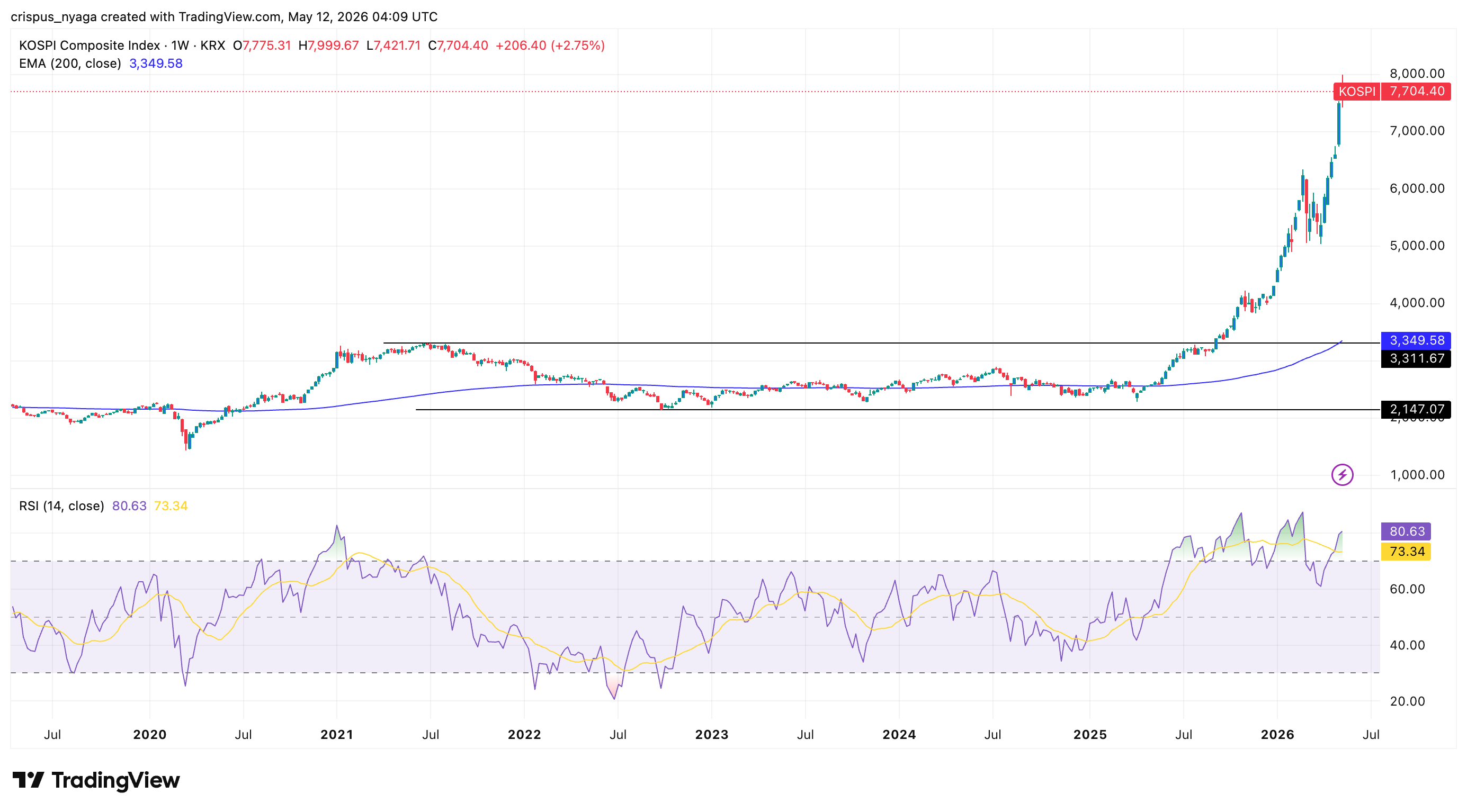
Kospi Index chart | Source: TradingView
Therefore, while the Kospi Index rally may continue in the near term, there is a risk that it will suffer a major reversal in the coming weeks or months. This drop will be brutal as it will push more retail investors to sell their holding in panic.
The post JPMorgan, Citi are bullish on the Kospi Index rally, but beware of crucial risks appeared first on Invezz